Learn
Get it right and it moves further away.
Soar is classroom software that runs on your computer. This page covers only the learning side of it: the part in charge of remembering.
If you haven't reviewed something, it says you haven't.
Words and questions line up in one queue, ordered by when you're about to forget. Flip through the stack and the day is done.
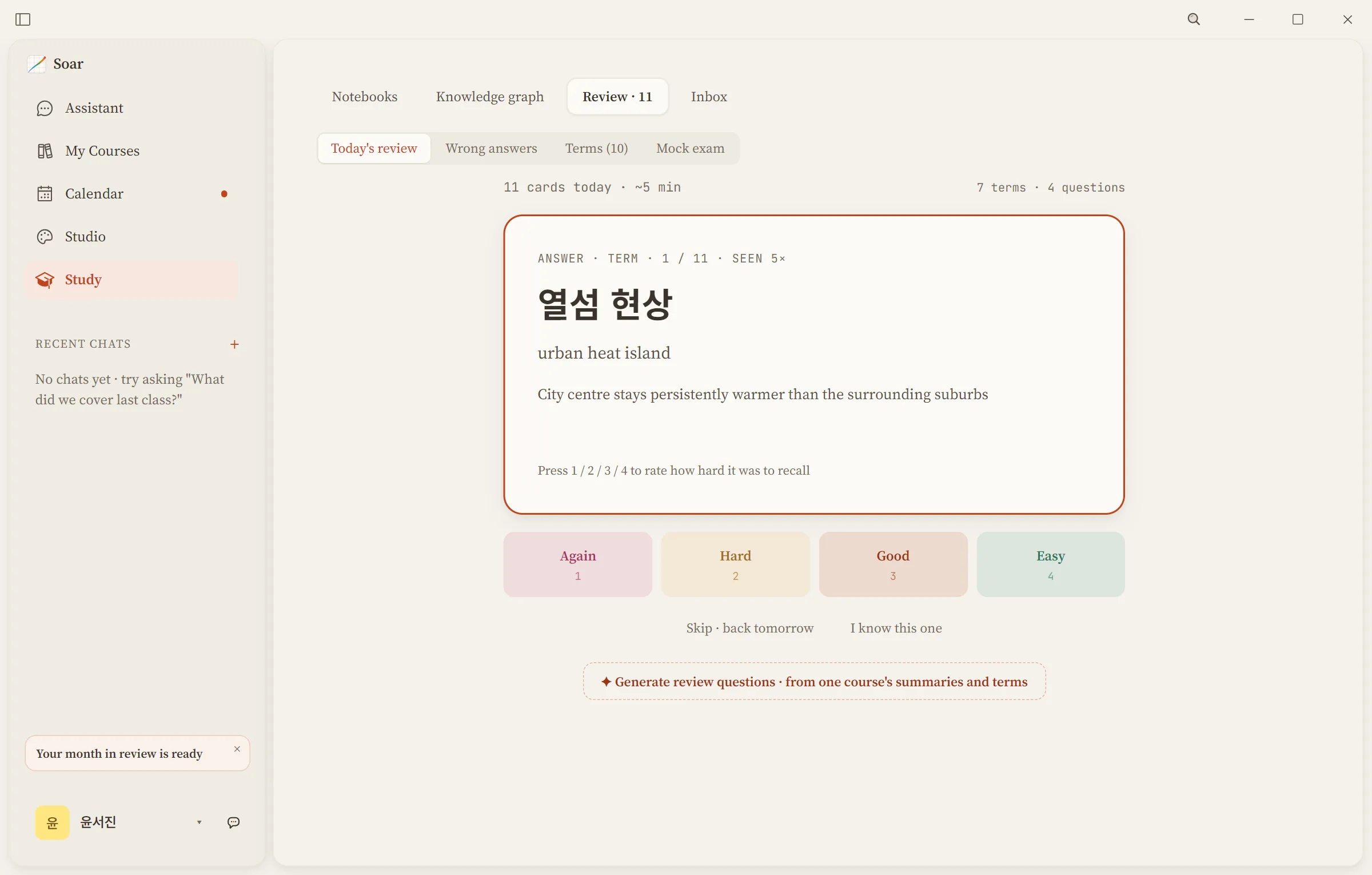
The “minutes” on those keys are gone
In an early version the four rating keys read “Again 1 min · A bit hard 6 min · Got it 10 min · Too easy 8 days”: two different units in one row. Those three minute figures came from the scheduling library's default “learning steps,” copied straight through; they predicted nothing about your memory.
Learning steps assume you sit down and drill for an hour. This queue comes around once a day, so those 10 minutes never actually arrive. Since we switched them off in August 2026, the four keys read 1 / 2 / 3 / 8 days.
Tonight
Today's review
Words and questions share one queue, ordered by when you're about to forget.
cognitive load
word · Cognitive Psychology
Tap to flip
how much working memory is in use
The core constraint in instructional design.
About how many “chunks” can working memory hold at once?
question · Lecture 2
Tap to flip
About four
Any more won't fit, so we “chunk” scattered bits into packages.
grouping scattered items into one unit
word · Lecture 2
Tap to flip
chunking
How you stretch working memory's small limit.
«working memory» is:
word · Lecture 3
Tap to flip
Small, live, seconds long: the bottleneck of the whole memory chain.
Working memory holds only about four ____.
word · Lecture 3
Tap to flip
chunks
The harder it is to recall, the better it sticks. That is memory science.
Did you remember?
· . It won't nudge you again today.
“Again” costs you nothing. On a word card, we also quietly slip in one targeted practice question.
Forgetting is normal. It doesn't mean you did anything wrong.
Today's review is done.
Get through the stack and what mattered is holding. Come back tomorrow and a few new ones will be waiting in the queue.
We keep your streak too, but it never nags, never ranks, and says nothing when it breaks.
The same card, asked a different way
Recognize it, meaning → word, multiple choice, fill in the blank: it rotates with each review, then starts over from the top.
Multiple-choice distractors are pulled from your own word bank, across all courses. Fill in the blank only comes up when the word has an explanation from class and that explanation uses the word itself.
After a wrong answer
Wrong answers graduate
The wrong-answer book is a ladder. Get it right twice and it graduates out.
Which memory is the small, live, seconds-long workspace?
You picked “sensory memory”
You picked “sensory memory”, but that's the millisecond-long input gate; the “small, live, seconds-long workspace” is working memory. You mistook the doorway for the desk.
Which is the active, moment-to-moment workspace?
You picked “short-term memory”
You picked “short-term memory”, an older term often confused with working memory. The difference: short-term memory only holds; working memory also manipulates.
Chunking directly expands the effective capacity of what?
You picked “attention span”
You picked “attention span”. Chunking does rely on attention, but what it expands is how many units working memory can hold at once (turning 1-9-4-9 into “1949”).
The wrong-answer book is empty.
You don't need them anymore. You took them down, one by one.
An emptying book is hope, not a pillory.
If you haven't reviewed it, it says “not reviewed yet.”
How much stuck
Honest mastery
A star's color is its concept cluster; the gray ones are the ground ahead you haven't touched yet. Mastery lives in the panel that opens when you tap one.
cognitive load
Mastery: not reviewed yet
color = concept cluster · size = connections · gray = not touched yet
A new concept is a new concept. We won't hand you a fake “50%”.
Those numbers move with you
“Review intensity” has three settings. Tighten it and “Easy” shrinks from 8 days to 4; loosen it and it stretches to 16.
The default setting is the 1 / 2 / 3 / 8 days printed on the keys.
From read to remembered
From reading it, to remembering it
Notes and sources in one place. Ask them, generate from them, and it flows into the spaced queue in one tap.
How do chunks and working memory relate?
Chunking packs scattered bits into one meaningful unit1, directly expanding how much working memory can hold at once2.
Tap a superscript to see which source it's based on.
From these sources, generate
Chunking directly expands the capacity of what?
Working memory (units held at once).
Packing scattered bits into a meaningful unit is called?
Chunking.
We carry what you read all the way to remembering it.
It won't pretend you've reviewed it
The colors, the numbers, that progress bar: every one of them comes from something you actually did. Where you haven't, it stays empty.